Planning for the next cherry blossom season
Forecast status checked on 28 October 2026. The Japan Meteorological Corporation (JMC) forecast page and Japan National Tourism Organization (JNTO) guide checked for this article still display 2026 information. The guidance below is for planning; it is not a confirmed 2027 city-by-city forecast. Do not reuse last season’s dates as predictions for your next trip.
The Japan cherry blossom season, known locally as sakura, is one of the most beautiful times of the year to visit the country. Every spring, delicate pink and white blossoms blanket parks, gardens, and historic landmarks, creating postcard-perfect scenery that draws millions of travelers from around the world.
For the Japanese, cherry blossoms are more than just flowers. They symbolize renewal, hope, and the fleeting beauty of life. This cultural significance makes the season even more meaningful, turning it into a celebration that blends nature, tradition, and community.
During the cherry blossom season in Japan, locals and visitors gather for hanami, or flower-viewing parties, under the blooming trees. It’s a time to enjoy food, laughter, and the company of loved ones while admiring the breathtaking view of sakura in full bloom.
Whether you’re exploring Tokyo’s bustling parks, Kyoto’s tranquil temples, or rural towns with hidden cherry tree-lined paths, the Japan cherry blossom season offers a once-in-a-lifetime experience. It’s not just about seeing flowers. It’s about feeling the spirit of spring and being part of a tradition that has been cherished for centuries.
When is cherry blossom season in Japan?
There is no single nationwide date for the Japan cherry blossom season. Late March to early April is a useful starting point for many popular mainland cities, while northern areas generally flower later. Local weather, elevation and cherry-tree variety can change the timing.
Typical seasonal windows, not annual forecasts: use these broad patterns to choose a region, then check that season’s forecasts and local bloom reports closer to travel.
| Region | General planning window |
|---|---|
| Okinawa | Usually mid-January to mid-February; its common cherry variety differs from mainland Somei-Yoshino. |
| Tokyo and many popular central/western mainland cities | Often late March to early April, with differences between cities and varieties. |
| Tohoku | Generally April; northern and higher areas can be later. |
| Hokkaido | Generally late April into May, depending on the location. |
For regional context, see JNTO’s seasonal overview, GO TOKYO’s blossom guide and the official Okinawa cherry blossom guide. These seasonal patterns are not guarantees of flowers on a particular date.

Where to see cherry blossoms in Japan
Experiencing the sakura season in Japan feels magical no matter where you are, but some places are especially famous for their blooms.
- Tokyo: Ueno Park and Shinjuku Gyoen are iconic for hanami picnics.
- Kyoto: Maruyama Park, Philosopher’s Path, and Kiyomizu Temple are must-sees.
- Osaka: Osaka Castle Park and Kema Sakuranomiya Park offer incredible river views.
- Hiroshima: The Peace Park and Shukkeien Garden turn into pink wonderlands.
- Smaller towns: Consider places such as Kawagoe or Takayama as part of a wider itinerary, but check their local bloom timing rather than assuming it matches Tokyo or Kyoto. Popular viewing spots can still be busy.
Some parks and temples hold yozakura, or night-time cherry blossom illuminations. Check the venue’s current event dates, opening hours, admission rules and reservation requirements; last year’s programme may not apply to your visit.
How long do cherry blossoms last?
The main blossom display at one location can be brief, often around one to two weeks, and the fullest display is a shorter part of that period. Different varieties can extend a garden’s overall season. GO TOKYO’s guide explains why variety and timing matter.
That said, the exact timing is never guaranteed. Weather shifts, an early warm spell or unexpected rain, can speed up or shorten the season. Flexibility is important when planning your trip.
How to read a cherry blossom forecast
First flowering and full bloom are different. JMC bases its forecasts on standard observation criteria: first flowering means roughly five or six open flowers on a sample tree; full bloom means roughly 80% or more of its buds have opened. Neither tells you that every tree in the city will look the same. See JMC’s forecast explanation.
Check the forecast year, publication date, location and whether the date means first flowering or full bloom. An early forecast is an estimate, not a promise. As your trip approaches, compare it with current reports from the park or city you plan to visit.
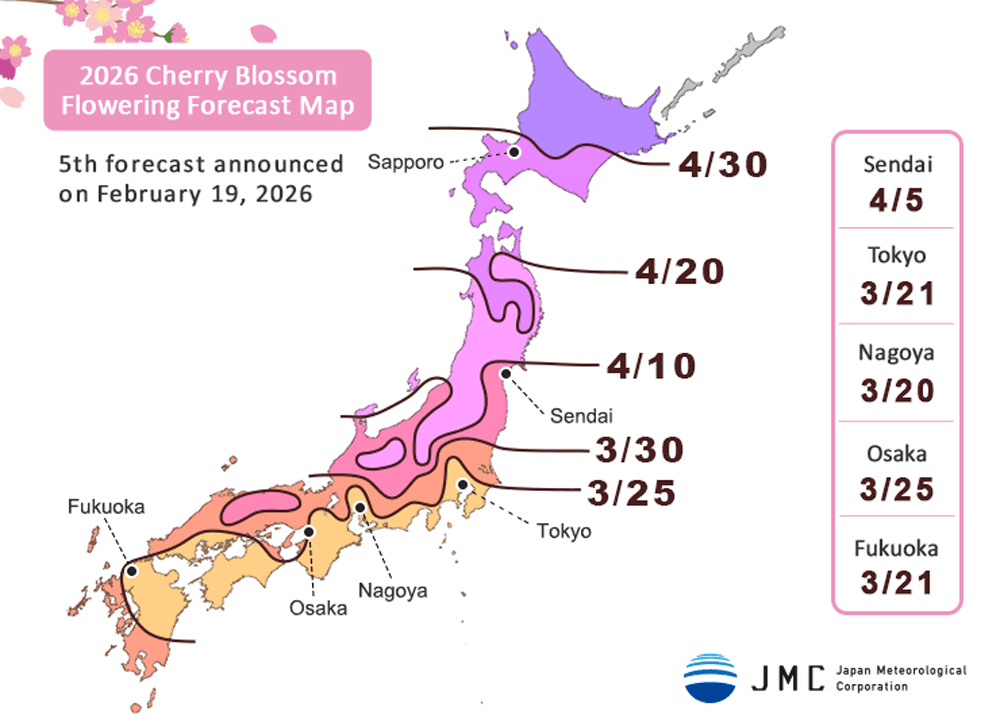
2026 forecast graphic: historical reference only
The graphic below is retained from the earlier article and is dated 19 February 2026. It is an old prediction, not a record of actual flowering and not a forecast for 2027. JMC later issued its final 2026 forecast on 23 April 2026. Use the provider’s latest release rather than this archived image for planning.
Practical planning before the next forecast
- Choose a region before choosing a single bloom date. Build a trip you will enjoy even if flowering is early or late, with food, culture and indoor options alongside the parks.
- Allow more than one viewing opportunity. A few days in a base city gives you more flexibility than one fixed afternoon. Keep some day plans adjustable.
- Read booking conditions. Compare cancellation and change terms before committing to flights, hotels or tours. A blossom forecast does not guarantee a refund if the timing changes.
- Check local rules. Confirm tickets, opening hours, picnic restrictions and illumination dates directly with each venue. Do not assume every park allows the same activities.
- Recheck the season’s information before departure. Use a dated forecast for the correct year, then look at local bloom reports as your visit approaches.
Travelution Holidays can help you compare flights, hotels and a practical Japan itinerary around your preferred travel window. If you would like to combine Hokkaido sightseeing with Club Med Kiroro Grand or Club Med Kiroro Peak, ask us to check the resort’s operating season and availability for your dates separately from the blossom forecast.